
Lapeer County Arrest Records and Court Charges
A Lapeer County arrest record is the account of an arrest itself. It names the person taken into custody, the arresting agency, the date, and the booking details logged when someone is brought to the county jail. An arrest does not decide guilt. It only starts the process. After booking, the Lapeer County Prosecuting Attorney reviews the police report and decides which formal charges to file. Those charges are entered with the court and become the court charge record. The two records answer different questions. One shows that an arrest happened. The other shows what the state accuses the person of doing.
The charges after arrest carry the most weight for anyone reading a case. They set the possible penalties, the court that hears the matter, and the path the case will take. In Lapeer County, felony and misdemeanor charges move through the 71A District Court and the 40th Circuit Court. Booking sheets and jail data stay on the sheriff side of the line.
Lapeer County Arrest Records vs the Court Charge Record
The arrest side and the charge side live in different places. The Sheriff's Office handles the arrest, the booking, and the jail file. The court and the prosecutor handle the charges. Keeping the two apart saves time, because searching the wrong system usually returns nothing.
The Sheriff's Office explains its report and record duties on the Sheriff Records Division page.
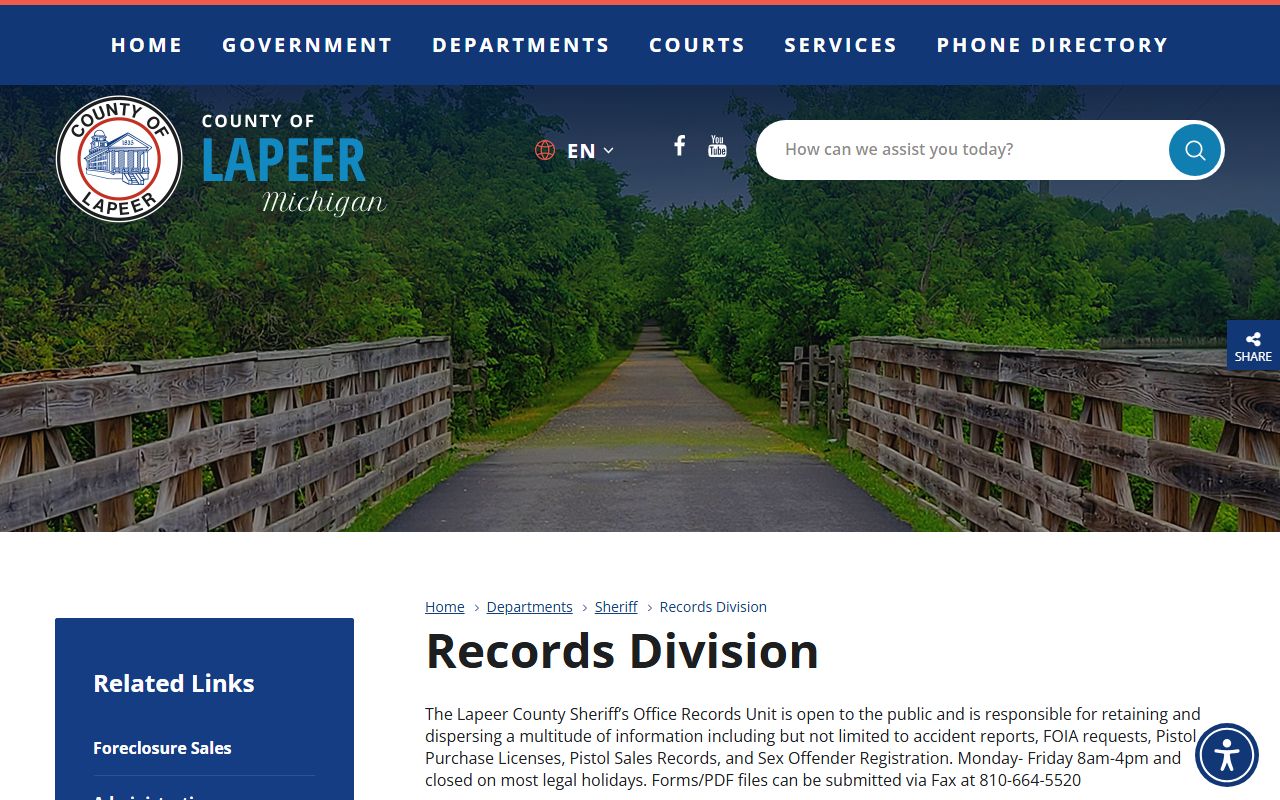
Booking sheets, arrest reports, and custody status come from that division, not from the court clerk.
For who is in custody right now and the booking detail tied to an arrest, the jail roster is the better source. That side is covered on the Lapeer County inmate records page. The court charge record picks up once the prosecutor files. For the full case file, the pleas, and the sentence, the criminal court records page follows the case all the way to its end.
How to Find Lapeer County Arrest Records and Charges
Court charges show up in the trial court case index. Michigan runs a single public case search for its trial courts. It covers the 71A District Court and the 40th Circuit Court, so most Lapeer County charges appear there under a defendant's name or a case number.
- Open the MiCOURT trial court case search and select the Lapeer County courts.
- Search by defendant name, or enter the case number if you already have it.
- Open the matching case to see the charge list and the register of actions.
- Read each charge line for its statute code, its level, and its current status.
- For arrest or booking detail that is not in the court file, contact the Sheriff's Records Division.
Statewide history is a separate product. The Michigan State Police ICHAT service sells criminal-history reports, and appeals use the Michigan Courts case search. Neither one replaces a certified court file from the clerk.
Note: MiCOURT shows docket text and case status, but downloadable documents and certified copies still come from the clerk of the court that holds the file.
Who Files Charges After a Lapeer County Arrest
Police make the arrest. The prosecutor decides the charges. In Lapeer County that decision belongs to the Prosecuting Attorney, John D. Miller, whose office reviews the reports and files the formal charges with the court. The office also carries duties to crime victims under the Michigan Crime Victim's Rights Act, which is why victim-service and notice fields often appear inside criminal dockets.
More than one agency can make the arrest that starts a case. The City of Lapeer lists its police department on the city contact page.

A city officer, a sheriff's deputy, or a state trooper can each bring the arrest that a county charge is built on.
- Lapeer County Sheriff's Office
- City of Lapeer Police Department
- Michigan State Police, Lapeer post
How Charges Are Filed: Complaint, Information, and Indictment
The charge record begins with a charging document. It is the paper that tells the court and the defendant exactly what is alleged. Michigan cases usually open with a complaint. A felony that survives a preliminary examination moves forward on an information filed in Circuit Court. Grand jury indictments exist too, but they are far less common at the county level.
| Complaint | Information | Indictment | |
|---|---|---|---|
| What It Is | Sworn statement of the charge | Formal felony charge after bindover | Charge returned by a grand jury |
| Filed By | Officer or prosecutor | Prosecutor | Grand jury |
| Common For | Misdemeanors and the start of felonies | Many felonies | Serious or complex felonies |
| Which Court | 71A District Court | 40th Circuit Court | 40th Circuit Court |
Charge Codes and Severity Levels in Michigan
Every charge points to a statute. The code on a charge line links the accusation to the exact Michigan law it is built on, and that code also signals how serious the charge is. One arrest can produce several separate charges, each with its own code and its own possible penalty. That is why a single case can list a felony, a misdemeanor, and a civil infraction all at once.
- Felony
- A crime with a possible penalty of more than one year, handled in the 40th Circuit Court after bindover.
- Misdemeanor
- A crime punishable by up to one year, handled from arraignment through sentencing in the 71A District Court.
- Civil infraction
- A ticketed violation, such as most traffic matters, that is not a crime and carries fines instead of jail.
Charge Status in Lapeer County Court Records
A charge is not fixed once it is filed. As a case moves, charges can be added, changed, or dropped, and the record shows each shift. Reading the status field is the only reliable way to know where a charge stands today. A count that was reduced or dismissed months ago should no longer read as pending.
| Status | What It Means |
|---|---|
| Pending | Filed and still active, not yet resolved. |
| Amended | Rewritten by the prosecutor, often to change the count or the statute. |
| Reduced | Lowered to a less serious charge, such as a felony cut to a misdemeanor. |
| Dismissed | Dropped by the court, which ends that charge. |
| Nolle Prosequi | The prosecutor's decision to drop the charge before a verdict. |
| Bound Over | Sent from the 71A District Court to the 40th Circuit Court after a felony preliminary exam. |
Note: A dropped or reduced charge does not erase the arrest that led to it, which can still appear in law-enforcement and criminal-history records.
Requesting Lapeer County Booking and Arrest Reports
Lapeer County does not publish a public online booking roster. The current jail list is posted in the jail lobby, so arrest and booking records usually come through a direct request. The Sheriff's Records Division handles arrest reports, incident reports, and related law-enforcement files. A written public-records request is the standard channel when a record is not available at the counter.
The office structure and duties are laid out on the Sheriff administration page.
Records staff can confirm which reports are releasable, since active investigations and juvenile matters may be withheld. County requests can also go through the county FOIA page, which offers both a form and an email channel.
Sheriff's Records Division
3231 John Conley Dr.
Lapeer, MI 48446
810-664-1801
Records fax 810-664-5520
Mon-Fri 8:00 a.m.-4:00 p.m.
Prosecuting Attorney's Office
255 Clay St.
Lapeer, MI 48446
810-667-0326
Mon-Fri 8:00 a.m.-4:30 p.m.
Charges vs Convictions
A charge is an accusation. A conviction is a finding of guilt. The gap between the two matters, because a record can show a charge that was later dropped, dismissed, or never proven at all. Reading a filed charge as proof of guilt is a common and costly mistake.
| Charge | Conviction | |
|---|---|---|
| Stage | Accusation | Verdict or plea |
| Burden of Proof | Probable cause | Beyond a reasonable doubt |
| Who Decides | Prosecutor | Judge or jury |
| Public Record | Yes | Yes |
Important: A filed charge only means the state has accused someone. It is not proof of guilt, and many charges end without a conviction.
Statewide Charge and Criminal History Lookups
County court files show local cases, but some searches reach further. ICHAT returns a statewide criminal-history report for a fee. The Michigan Department of Corrections OTIS system tracks people in state prison, on parole, or on probation. Each tool answers a different question, and none of them is a certified court record on its own.
Certain convictions also feed the Michigan Sex Offender Registry.
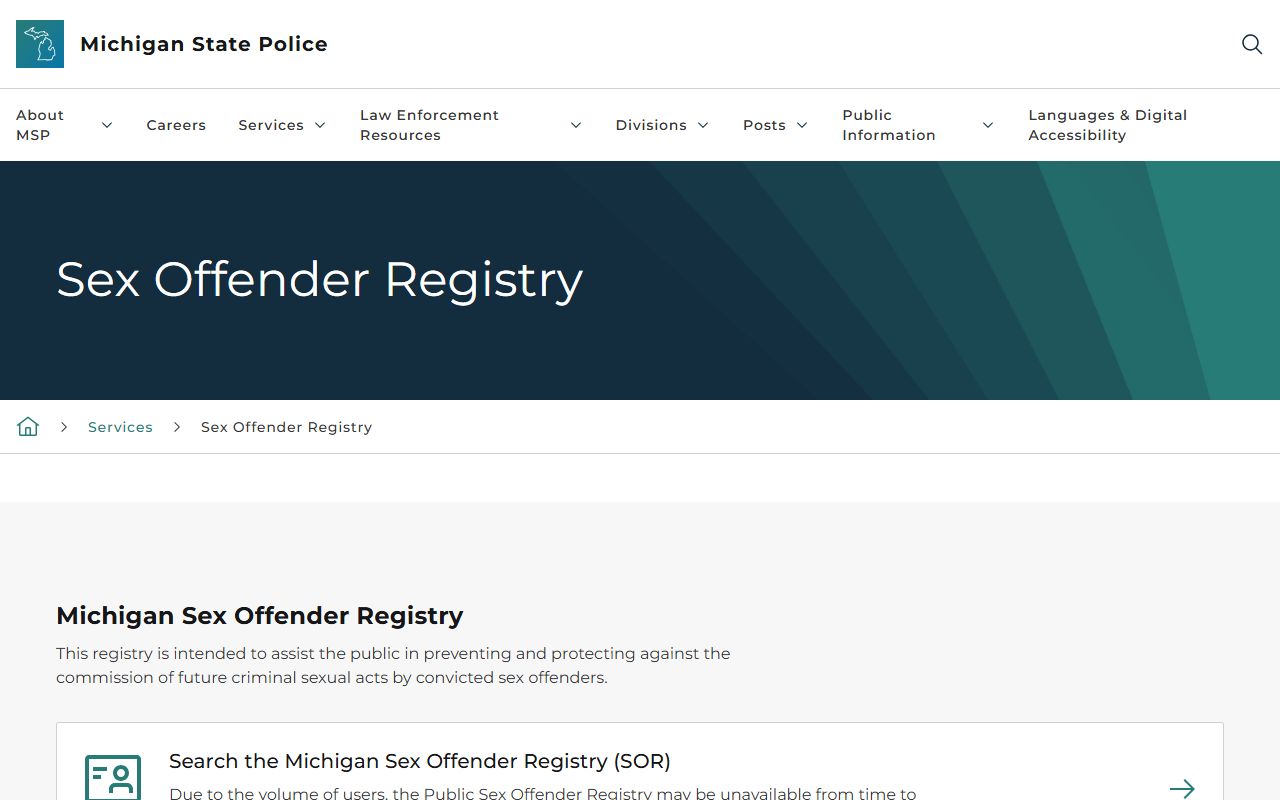
The registry is a public safety tool, and it stands apart from the court file and the county jail roster.
- ICHAT: statewide criminal-history reports from the Michigan State Police, for a fee.
- OTIS: state prison, parole, and probation status from the Department of Corrections.
- Sex Offender Registry: a public listing of registered offenders maintained by the state.
Important: This site is not a consumer reporting agency under the Fair Credit Reporting Act, and its information cannot be used for employment, tenant, credit, or similar screening decisions.
Federal Charges in Lapeer County Cases
Not every serious charge stays in county court. Some conduct is charged as a federal crime, and those cases never appear in the county case index. Lapeer County sits in the U.S. District Court for the Eastern District of Michigan, which hears federal criminal matters for this part of the state.
Federal filings run through the Eastern District of Michigan court system.
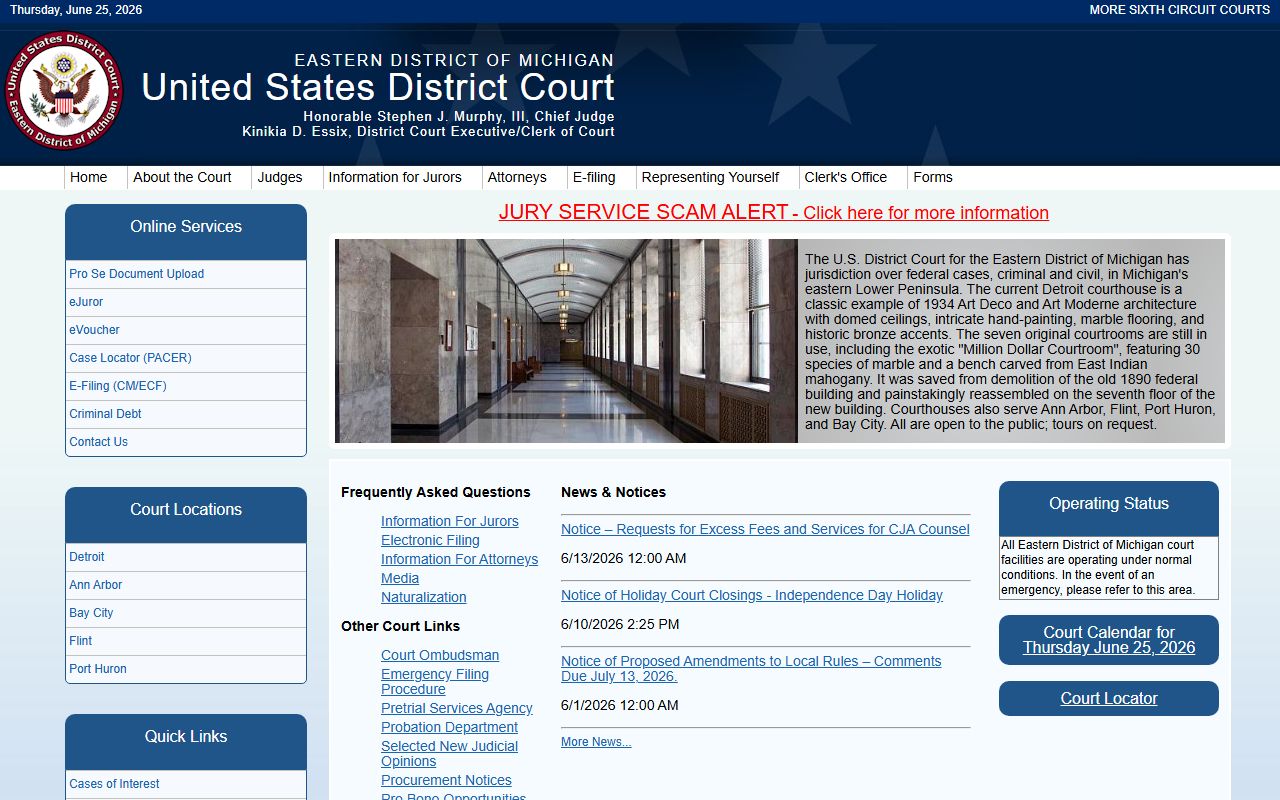
Federal charge records are viewed through PACER, the electronic access system, rather than the state trial-court search. A federal case and a county case can involve the same person yet live in completely separate files.
Sealed and Expunged Charge Records in Lapeer County
Michigan uses the term set aside for what many people call expungement. A set-aside order makes an eligible conviction nonpublic, so it should no longer appear in ordinary MiCOURT or ICHAT searches. Sealing is a related idea, where a court blocks public access to a record or part of one under Michigan court rules. The Clean Slate law also sets aside many eligible convictions automatically after a waiting period.
- Sealed
- Public access is blocked by court order or rule, though limited official access may remain.
- Set aside (expunged)
- An eligible conviction is made nonpublic under Michigan law, by application or automatically.
- Clean Slate
- The automatic process that removes eligible convictions from public view after set statutory periods.
Restricted Charge Records in Lapeer County
Some charge records never reach the public search, and others are pulled from view. Juvenile cases are restricted under Michigan law, so a name search rarely returns them. Sealed search warrants and sealed indictments stay hidden until a court unseals them. Records tied to an open investigation can be withheld, and the prosecutor is not required to release information about a crime still under review.
Protected personal details are redacted even inside public files. Social Security numbers, financial-account numbers, some birth dates, minor names, and victim information are all stripped out before a record is released. Anyone who needs a complete and certified account should go to the court that holds the case rather than rely on a summary.
Note: A charge missing from an online search is not proof it never existed, since sealed, juvenile, and set-aside records are kept out of public results by design.