
How to Search Lapeer County Court Records
Most court searches in the county begin with MiCOURT Case Search. This free statewide portal is the first stop for the 40th Circuit Court, the 71A District Court, and the Lapeer County Probate Court. It can show civil, traffic, criminal, family, and probate cases, depending on the court you pick. The tool gives you the index, docket, party names, hearing dates, and case status. It does not hold every filed paper. For copies of the documents themselves, you contact the court office that owns the file.
The county government site is the easiest way to reach the right court link before you search. The Lapeer County government homepage lists departments, courts, and the sheriff on one page.
From that homepage the courts menu routes straight to the case-search tool and each individual court page. Pick the court level first, then search by name or case number.
Before you start, gather a few details. A case number is the cleanest search key, since common surnames in the county can return many people. If you only have a name, use the exact last name and first name. Criminal searches in some Michigan courts may ask for a date of birth to cut down on wrong matches.
- Open MiCOURT Case Search or start from the Lapeer County courts page.
- Choose the court level. Pick the 40th Circuit Court, the 71A District Court, or the Lapeer County Probate Court.
- Search by case number if you have it, or enter the party last name and first name.
- Add a date of birth or case type when the court asks, then submit the search.
- Open the matching result and note the case number, court, filing date, status, parties, judge, and hearing dates.
- Request a copy from the court office if the document you need is not online.
The portal exposes several search fields. The table below lays out what the MiCOURT form asks for and how each field behaves.
| Field | Type | Notes |
|---|---|---|
| Court | Court selector | Choose 40th Circuit, 71A District, or Lapeer Probate Court. |
| Search mode | Tab or radio | Name or party search and case-number search. |
| Last name / business | Text | Party surname or organization name; partial names return broad lists. |
| First name | Text | Narrows an individual party search. |
| Date of birth | Date | Often needed for criminal searches to reduce mistaken identity. |
| Case number | Text | Michigan format such as 24-12345-FH or 25-000001-GC. |
| Case type | Dropdown | Criminal, civil, traffic, domestic, or probate when the court exposes it. |
Note: MiCOURT shows docket text and case status, but full pleadings and certified copies usually still require a request to the Circuit Court, District Court, or Probate Court office.
The Lapeer County Judicial System
Michigan runs its trial work through three local courts, and Lapeer County uses all three. The 40th Circuit Court is the court of general jurisdiction. It hears felony cases after bindover, civil claims above the district limit, divorce and family matters, personal protection orders, and appeals from the lower courts. The 71A District Court is the limited court. It handles misdemeanors, traffic tickets, civil infractions, small claims, landlord-tenant cases, and felony preliminary exams. The Probate Court takes estates, wills, guardianships, conservatorships, trusts, and mental health matters.
Cases move up a clear ladder. A felony starts in the District Court for arraignment and a preliminary exam, then binds over to the Circuit Court. Appeals from Circuit and Probate cases go to the Michigan Court of Appeals, and the Michigan Supreme Court is the last stop.
Case flow: Michigan Supreme Court › Michigan Court of Appeals › 40th Circuit Court › 71A District Court / Lapeer County Probate Court
The county courts page pulls all of these links into one place. The county courts landing page connects to each court, the dockets, and online payments.
That single landing page is the map most residents use to figure out which court owns their Lapeer County court records. The table below sorts the main courts by what each one hears.
| Court | Jurisdiction | Case Types |
|---|---|---|
| 40th Circuit Court | General trial court | Felonies after bindover, civil over $25,000, divorce, family, PPOs, appeals |
| 71A District Court | Limited trial court | Misdemeanors, traffic, civil to $25,000, small claims, landlord-tenant, arraignments |
| Lapeer County Probate Court | Specialized trial court | Estates, wills, guardianships, conservatorships, trusts, mental health |
| Michigan Court of Appeals | Intermediate appellate | Appeals from Circuit and Probate Courts |
| Michigan Supreme Court | Highest state court | Final review of state cases |
Lapeer County Courthouses and Court Offices
Nearly all court business in the county runs through one address. The Lapeer County Complex Building at 255 Clay Street holds the Circuit Court, the District Court, the Probate Court, and the County Clerk. Each office has its own suite, phone line, and set of hours. The Circuit Court Clerk sits on the second floor in Suite 227. The Sheriff and the county jail sit apart from the complex on John Conley Drive.
The 40th Circuit Court page spells out the clerk role and the office details for felony and family files. The 40th Circuit Court page lists jurisdiction, the clerk duties, and the judge schedules.
That page confirms the Circuit Court Clerk handles pleadings, dockets, and certified copies for the general trial court. The three cards below give the direct contacts for the main courts at 255 Clay Street.
40th Circuit Court
255 Clay St., Suite 227
Lapeer, MI 48446
810-667-0358
Mon-Fri 8:00 a.m.-4:30 p.m.
71A District Court
255 Clay St.
Lapeer, MI 48446
810-667-0314
Lobby 8:00 a.m.-4:30 p.m.
Lapeer County Probate Court
255 Clay St.
Lapeer, MI 48446
810-667-0261
Mon-Fri 8:00 a.m.-5:00 p.m.
The County Clerk, Theresa Spencer, also serves as Clerk of the 40th Circuit Court, so vital records and circuit case files route through the same elected office at 255 Clay Street.
Types of Court Records Available in Lapeer County
Court records in the county fall into a handful of clear groups. The court that made the record decides where you go to find it. Civil and felony files sit with the Circuit Court. Traffic, misdemeanor, and small claims files sit with the District Court. Estates and guardianships sit with the Probate Court. Sheriff arrest reports and jail records are not court records at all, and those come from the Sheriff's Records Division.
The 71A District Court page shows how the busiest record types, traffic and misdemeanors, move through the limited court. The 71A District Court page outlines its civil, traffic, and criminal work.
That page confirms the District Court is where most residents first meet the court system, through a ticket or a small claim. The list below breaks the main record types down by court.
- Criminal records - felony files at the Circuit Court and misdemeanor files at the District Court.
- Civil records - claims over $25,000 at Circuit Court and claims up to $25,000 at District Court.
- Family and divorce records - divorce, custody, and paternity at the Circuit Court Family Division.
- Probate records - estates, wills, guardianships, and conservatorships at the Probate Court.
- Traffic records - tickets and civil infractions at the 71A District Court Traffic Division.
Small claims cases live inside the District Court civil division and cap at $6,500. In small claims, both sides give up the right to a lawyer and a jury, though either party can move the case to general civil.
What Lapeer County Court Records Show
A court record is built from a set of standard fields. Once you know the fields, any Michigan case file reads the same way. The case number carries the year, a sequence number, and a two-letter code for the case type. The rest of the record tracks who is involved, what the court did, and how the case ended. Financial fields cover fines, costs, restitution, bond, and any judgment.
The County Clerk keeps and certifies these files for the Circuit Court. The Lapeer County Clerk page describes the office as the county's keeper of the records.
That role is why a certified Circuit Court record request goes to the County Clerk. The table below walks through the common fields you see in a Lapeer County court record.
| Field | What It Shows |
|---|---|
| Case Number | Year, sequence number, and a two-letter case-type code. |
| Filing Date | The date the complaint, petition, or citation began the case. |
| Parties | Plaintiff and defendant, or petitioner and respondent, or estate and heirs. |
| Charges / Cause | The criminal charge or the civil claim driving the case. |
| Disposition | The outcome, such as pending, dismissed, disposed, or bound over. |
| Sentence / Judgment | The penalty or the money award, plus probation or restitution terms. |
Docket entries fill in the story between filing and outcome. They log the complaint, the arraignment, motions, orders, hearings, and payments in date order.
Public Access Laws for Lapeer County Court Records
Two different rulebooks govern access in the county. Court case files follow Michigan court rules and the clerk's file procedures. County agency records, such as sheriff incident reports or jail administrative files, follow the Michigan Freedom of Information Act. That split matters. A request for a court file goes to the court, while a request for a sheriff report goes to the Sheriff's Records Division or the county FOIA coordinator.
Michigan policy leans toward openness, but the details sit in specific statutes and court rules. The callout below gathers the key authorities with a plain-English note on each.
Key Statutes:
MCL 15.231 - sets Michigan's policy that people may examine public records of government bodies.
MCL 15.234 - lets a public body charge limited labor, copy, and mailing fees for a FOIA request.
MCL 600.571 - makes the County Clerk the Clerk of the 40th Circuit Court in Lapeer County.
MCR 8.119 - governs how court records are kept and accessed, with limits for nonpublic material.
MCL 712A.28 - restricts public access to juvenile court records compared with adult files.
The county FOIA page explains where to send a records request. If you know the department that keeps the record, the request can go straight to it. Otherwise, the Administration Office FOIA coordinator sorts and routes it.
Note: a certified court disposition and a Michigan State Police ICHAT criminal history are different products, since ICHAT is a statewide search and the court file is the local case record.
Records That Are Restricted or Confidential
Not every case is open to the public. Michigan law shields several categories to protect children, patients, and crime victims. Juvenile delinquency and child protective cases run through the Circuit Court Family Division with tight access limits. Adoption files stay confidential. Mental health proceedings in the Probate Court involve medical detail, so those records are restricted. Set-aside and Clean Slate convictions become nonpublic and drop out of ordinary searches.
Some fields get redacted even inside an otherwise public file. Social Security numbers, financial account numbers, certain birth dates, minor names, and victim information are withheld under court rule. Birth records less than 110 years old are confidential, and the County Clerk asks for eligibility documents and photo identification before releasing one.
A person trying to clear a Michigan conviction should first pin down the court, the case number, the charge, and the eligibility rules. Michigan's set-aside statute controls applications to clear eligible convictions, and the automatic Clean Slate process removes some convictions from public view after a waiting period. A set-aside makes a record nonpublic, though it does not always destroy it, and law enforcement or the courts may still see it in situations the statute allows.
Specialty Courts in Lapeer County
The county runs problem-solving programs alongside its regular criminal docket. The clearest one is the Mental Health Court and jail diversion path tied to Lapeer County Community Mental Health. Anyone can refer a person for jail diversion or the Mental Health Court. The referral line is 810-667-0500, and staff review each case one at a time. The main difference between jail diversion and the Mental Health Court is the level of care and support each track provides.
Community Mental Health publishes the referral details on its court services page. The Community Mental Health court services page explains the diversion and Mental Health Court process.
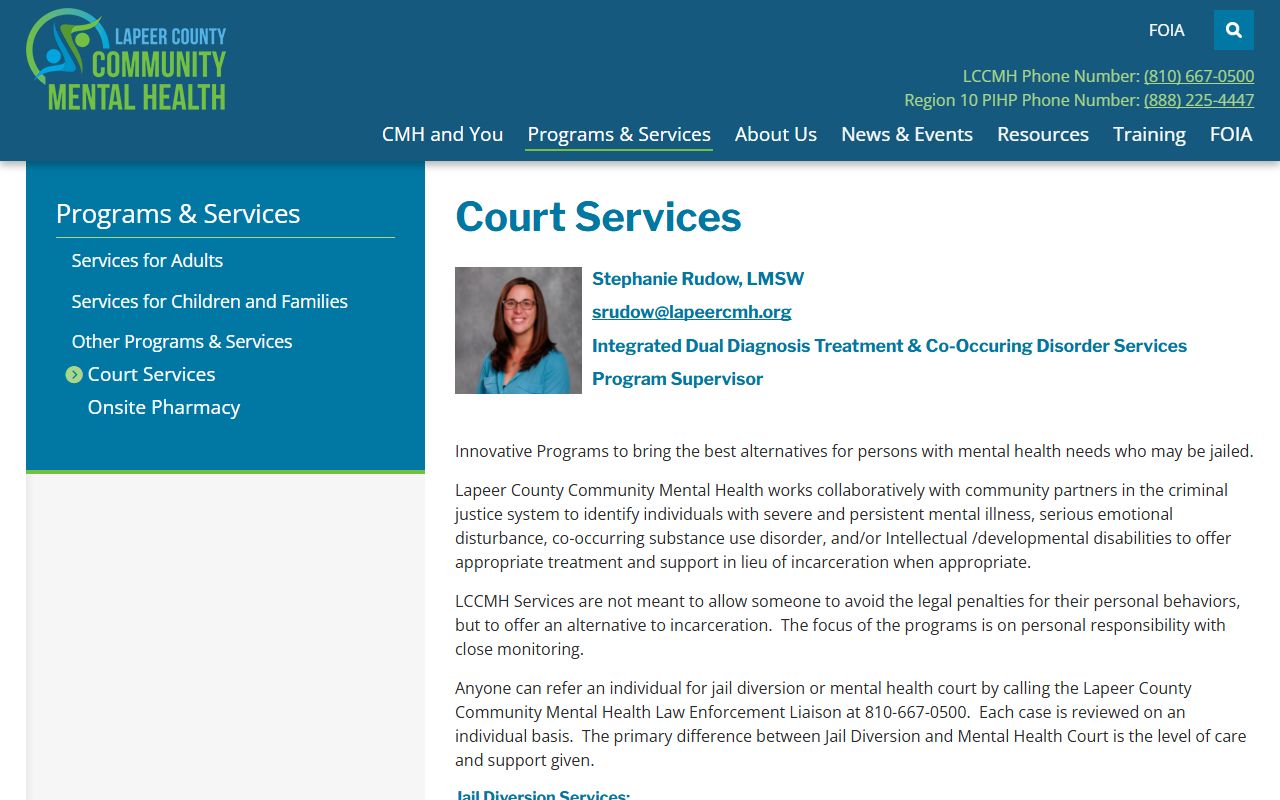
That page frames the program as a bridge between the criminal case and treatment, so participation can shape probation, compliance hearings, and sentencing. The county jail also runs in-house programs that support this work.
Jail-based services add another layer of rehabilitation. The programs list includes substance-abuse education, AA, domestic-violence support, anger management, parenting classes, and GED study. These are not separate courts, yet they often connect to the same treatment goals a specialty court sets.
Lapeer County Sheriff and Jail
Sheriff Scott McKenna has led the Lapeer County Sheriff's Office since 2017. The office covers all 666 square miles of the county. Its mission ties directly to the courts, since deputies protect the judiciary, carry out court orders, and run the county jail. The Sheriff's Office and jail sit at 3231 John Conley Drive, apart from the downtown court complex. The main phone line is 810-664-1801.
The Sheriff's main page lays out that court-focused mission. The Sheriff homepage describes the duty to execute court orders and hold inmates in custody.
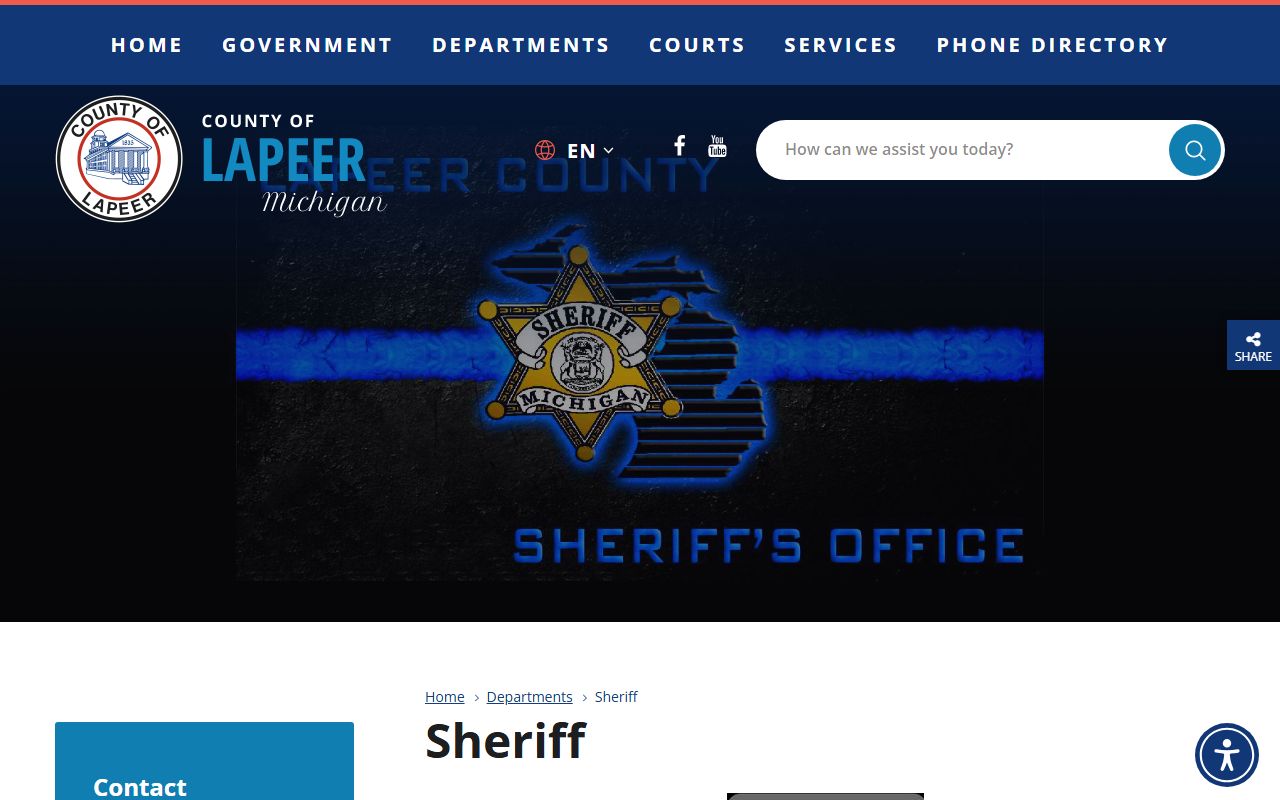
The jail was built in 1998 and holds 123 beds. It does not post a searchable roster online, and the county says the current inmate list is posted in the jail lobby instead. To confirm custody, callers use the jail phone line, visit the lobby, or file a records request, and the county's Lapeer County inmate records page walks through each of those channels in full. When someone needs to check on a court order tied to an arrest, the warrant records page lays out the court and sheriff fallback chain, since no public online warrant search was located.
Marriage, Divorce, and Probate Records
Family and estate records spread across two offices. The County Clerk issues marriage licenses and keeps marriage certificates that reach back to 1831. Divorce files sit with the Circuit Court Family Division, since the County Clerk also serves as Clerk of the 40th Circuit Court. Probate files, including estates, wills, and guardianships, stay with the Probate Court. Each office handles its own copies and certified records.
The definition list below explains a few probate terms that show up often in these files.
- Testator
- A person who makes a valid will to direct how their property passes after death.
- Executor
- The person named to carry out a will, also called a personal representative in Michigan.
- Conservator
- Someone the Probate Court appoints to manage another person's money or property.
- Guardian
- Someone the court appoints to make care and custody decisions for a ward.
- Intestate
- Dying without a valid will, which sends the estate through the state's default rules.
Divorce dockets are more open than adoption or juvenile files, yet Friend of the Court reports, financial identifiers, and minor details can still be redacted.
Lapeer County Court Records Fees
Fees depend on the office and the type of copy. Vital records run through the County Clerk. Certified copies of case documents and forms run through the District Court. Marriage license and ceremony fees follow their own set schedule. The amounts below come from the official county pages, so confirm current figures at the counter before you pay.
| Item | Amount |
|---|---|
| First certified birth, death, or marriage copy | $15.00 |
| Each additional copy of same record, same order | $5.00 |
| District Court certified copy | $10.00 plus $1.00 per page |
| District Court forms | $1.00 each |
| District Court appeal | $25.00 |
| Marriage license, Michigan resident | $20.00 |
| Marriage license, both out of state | $30.00 |
| District Court marriage ceremony | $10.00 |
Online vital-record orders through the county Permitium portal add a small service or card fee at checkout. The FOIA fee statute also lets county agencies charge for labor and copies when you request non-court records.
Note: a marriage license costs $20 for a Michigan resident and carries a three-day wait, and the license stays valid for 33 days from the application date.
How to Interpret Lapeer County Court Records
Reading a case file gets easier once the codes and terms make sense. The two-letter suffix on a case number names the case type. Common Michigan codes include GC for general civil, SC for small claims, LT for landlord-tenant, FH for a felony, and DM for a divorce with minor children. The status line tells you where the case stands, from pending to disposed to bound over.
One key point trips up many readers. A charge is not a conviction. The charge is the accusation the prosecutor files, and the disposition shows whether it ended in a plea, a dismissal, a verdict, or a set-aside. A bindover means a felony moved from the District Court to the Circuit Court after a preliminary exam found probable cause.
The county's court story helps explain why the modern file counters sit where they do. The City of Lapeer history page traces the courthouse back to the first court session in 1840.
That history explains the split between the landmark old courthouse and the working case counters at 255 Clay Street. For a statewide criminal history rather than a single case, the Michigan State Police ICHAT service and the MDOC OTIS offender search cover different ground than a local docket.
Accuracy and Record Limitations
Online court data can lag behind the paper file. A clerk enters new events into MiCOURT after the hearing or filing, so a fresh order may not show up right away. Some documents never post online at all, and older records may sit only in the court's own files. When a detail matters for a legal, job, or housing decision, the safe move is to confirm it with the office that owns the record.
Note: Always confirm case details with the Circuit Court, District Court, or Probate Court before you rely on any court record for a legal or financial decision.
History of Lapeer County Courts
Lapeer holds a rare piece of Michigan court history. The county's historic courthouse is a Greek Revival building that the county calls the oldest operating courthouse in the state still serving its original purpose. Alvin Hart built it at Nepessing and Court Streets in 1846 and rented it to the county for one dollar. The county then bought the courthouse in 1853. Court first met in the current building in April 1847.
The design is pure Doric. The county describes a two-story native white pine exterior on a brick foundation, a full-height portico with four fluted Doric columns, and a three-tiered tower at the rear. The building still hosts weddings and special events today.
The official building page carries the full construction story and the oldest-courthouse claim. The historic courthouse page details the Greek Revival features and the county's purchase in 1853.
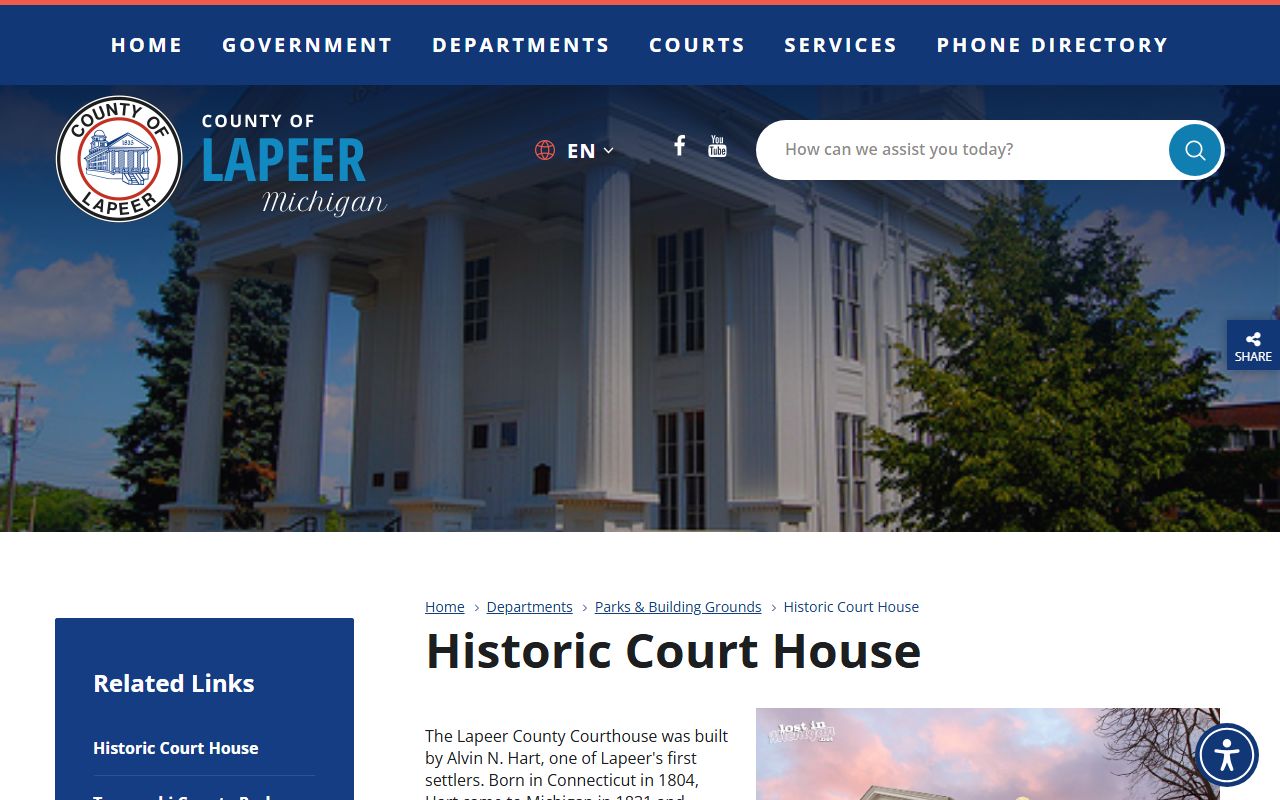
That landmark gives the county a strong visual identity, though the daily docket, payment, and case-file counters have moved to the modern complex at 255 Clay Street.
Frequently Asked Questions
Where do I start a Lapeer County court records search?
Start with MiCOURT Case Search, the free statewide portal. Pick the court level first. Choose the 40th Circuit Court for felonies and divorce, the 71A District Court for traffic and misdemeanors, and the Probate Court for estates and guardianships. Search by case number when you have it. If a document is not online, request a copy from the court office that holds the file.
Which court has my case?
The court that made the record keeps it. Felonies after bindover, civil claims over $25,000, divorce, and family cases sit with the 40th Circuit Court. Misdemeanors, traffic tickets, small claims, and landlord-tenant cases sit with the 71A District Court. Estates, wills, and guardianships sit with the Probate Court. Sheriff arrest and jail records come from the Sheriff's Records Division, not the courts.
Is there an online jail roster for Lapeer County?
No public searchable roster was found on the official county pages. The county says the current inmate list is posted in the jail lobby. To confirm custody, call the jail at 810-664-1801, visit the lobby, or file a records request. The Michigan Department of Corrections OTIS search covers state prisoners and parolees, but not pretrial county-jail inmates.
How do I get a certified copy of a court record?
Request the copy from the office that owns the file. The County Clerk handles Circuit Court and vital records. The District Court handles its own certified copies for a base fee plus a per-page charge. The Probate Court handles estate and guardianship copies. Certified copies carry a fee, and online docket views are not certified.
Are Lapeer County court records public?
Most are. Michigan court rules keep case files open unless a statute or order restricts them. Juvenile, adoption, mental health, and set-aside records are shielded, and some personal identifiers get redacted. County agency records like sheriff reports follow the Freedom of Information Act rather than court rules, so those requests go to the department that keeps them.
How do I check for a warrant in Lapeer County?
No official online warrant search was located, so you work the fallback chain. Call the 71A District Court at 810-667-0314 for traffic or misdemeanor bench warrants. Call the 40th Circuit Court at 810-667-0358 for felony matters. The Sheriff's Office executes court orders and keeps law-enforcement records. Active or sealed warrants may stay confidential before service.
How do I apply for a marriage license?
One applicant applies in person at the County Clerk's office at 255 Clay Street and brings valid documents for both applicants. Both parties must be at least 18. The fee is $20 for a Michigan resident and $30 if both live out of state. The day you apply starts a three-day wait, and the license stays valid for 33 days.
What is the difference between a court traffic record and a state driver record?
They are two separate files. The 71A District Court traffic record shows the citation, plea, hearing, disposition, and fines for the local case. The Michigan Secretary of State driver record shows license status, points, and driving history. The court reports convictions to the Secretary of State, and the magistrate cannot waive or reduce the points the state assesses.