
How to Search Lapeer County Traffic Court Records
Traffic cases in the county run through the Traffic Division of the 71A District Court. The first online lookup path is MiCOURT Case Search, the statewide trial-court portal. Pick the correct court before you type anything. Select 71A District Court, then search by citation number or by driver name. The portal returns index, docket, party, and status details rather than every scanned page. For older files, certified copies, or documents that are not posted, you still deal with the court counter.
Have a few things ready first. The citation or case number gives the cleanest match. A full name and date of birth help when the number is missing, because common surnames return more than one person. The broader set of Lapeer County court records uses the same portal, so the steps carry over to other case types.
The county district court page describes how tickets and criminal matters are handled at the same counter, which is the fastest way to confirm you are looking at the right division.
You can view the court's own summary of traffic and criminal case handling on the 71A District Court criminal and traffic cases page.
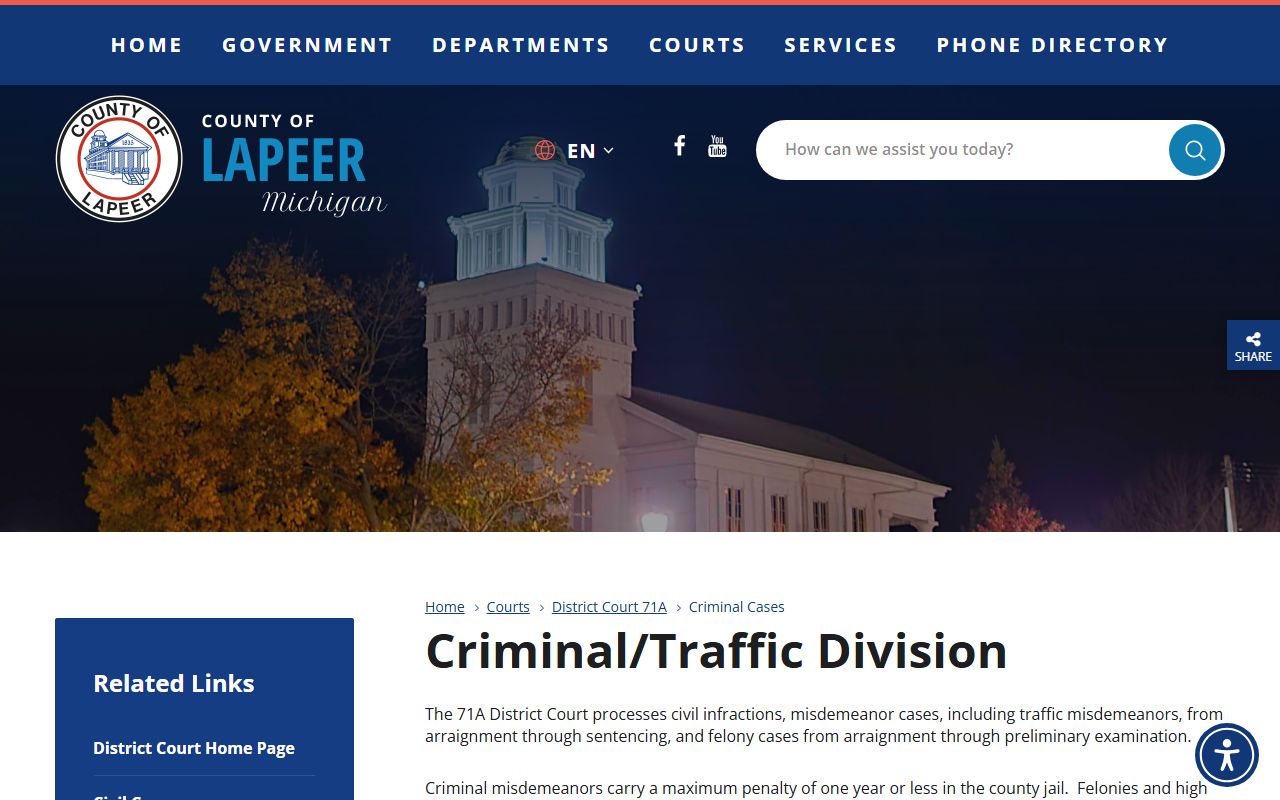
That page confirms the Traffic Division processes civil infractions and traffic misdemeanors, so a Lapeer County ticket search should always start with the 71A District Court selection.
- Open MiCOURT Case Search and choose 71A District Court from the court selector.
- Enter the citation or case number if you have it, or switch to a name search.
- Add a first name and date of birth to narrow a common surname.
- Open the matching result and read the charge, court dates, and status.
- Pay, request a hearing, or ask the counter for a certified copy.
Note: MiCOURT shows docket and status information for a Lapeer County traffic case, but full documents and certified copies still come from the 71A District Court counter.
The Lapeer County Traffic Citation Lookup Fields
The citation lookup uses a small set of fields, and knowing them saves time. Court selection is the one field you cannot skip. After that, the citation number does most of the work, while name and date of birth act as backups. A case-type filter separates a civil infraction from a traffic misdemeanor when a court exposes that option.
The table below lists the fields a Lapeer County traffic search uses, whether each one is required, and how to format it.
| Field Label | Type | Required | Options / Format Notes |
|---|---|---|---|
| Court | Dropdown | Yes | Select 71A District Court in MiCOURT. |
| Case / Citation Number | Text | Best if known | Ticket, citation, or case number. |
| Party Last Name | Text | Optional | Defendant surname. |
| Party First Name | Text | Optional | Narrows the search. |
| Date of Birth | Date | May be required | Helps avoid mistaken identity in traffic and criminal searches. |
| Case Type | Dropdown | Optional | Traffic civil infraction, traffic misdemeanor, or criminal-traffic. |
| Filing / Violation Date | Date | Optional | Use a date range when known. |
| Search / Submit | Button | Yes | Runs the query. |
A number search is exact, so it beats a name search almost every time. Use the name and birth date route only when the ticket is lost. If two matches share a surname, the date of birth and case type usually tell them apart.
Types of Lapeer County Traffic Cases on Record
Not every ticket is the same kind of case. Most stops end in a civil infraction, which is not a crime and carries a fine plus costs. Some conduct is charged as a traffic misdemeanor, which is a criminal matter with the chance of jail. The 71A District Court handles both, along with the criminal-traffic files that begin at the same counter. Sorting the type early tells you whether a fine settles it or whether a court date is real.
- Civil infractions - speeding, most moving violations, and equipment issues that carry fines and costs, not jail.
- Traffic misdemeanors - offenses such as driving on a suspended license that are criminal and can bring jail time.
- Criminal-traffic files - matters that begin with arraignment before a district court magistrate.
- Commercial vehicle violations - tickets that also reach the driver record an employer or CDL program reviews.
- Failure-to-comply matters - missed dates or unpaid tickets that can add a bench warrant to the file.
The label on the citation controls what happens next. A civil infraction lets a driver admit and pay, while a traffic misdemeanor follows the criminal steps of arraignment, plea, and sentencing.
What Lapeer County Traffic Court Records Show
A traffic court record is the case file the 71A District Court builds for one ticket. It tracks the charge, the schedule, and the result. It does not grade your driving history overall, and it does not set your points. The record proves what the court did with a single citation, which is why it matters when insurance, an employer, or an attorney needs the official outcome.
The fields below are the ones a Lapeer County traffic record commonly shows and what each one means.
| Field | What It Shows |
|---|---|
| Citation / Case Number | The unique number for the ticket and the court file. |
| Charge and Statute | The violation cited and the law it falls under. |
| Court and Hearing Officer | The 71A District Court and the judge or magistrate assigned. |
| Court Dates | Scheduled hearing, appearance, or payment deadlines. |
| Plea or Responsibility | Admit, admit with explanation, or deny responsibility. |
| Disposition | The final outcome, such as responsible, dismissed, or convicted. |
| Fine and Costs | The dollar amounts owed and any payment status. |
| Points Reported | Notation that the outcome was sent to the Secretary of State. |
Note: a crash or accident report is not part of the traffic court file, and those reports come from the Sheriff's Records Division through its CLEMIS report channel instead.
How to Pay or Contest a Lapeer County Traffic Ticket
A driver has real choices on a Lapeer County ticket, and the citation spells out the deadline. You can admit responsibility and pay. You can admit with an explanation, in writing to the magistrate or in person, and ask that the fine be adjusted. You can also deny responsibility and request a hearing. Payment is due within 28 days of the ticket unless the court grants an extension.
Hearings come in two forms. An informal hearing goes before the magistrate, and no attorneys take part. A formal hearing goes before the judge, where a prosecuting official represents the officer and the driver may bring an attorney. Payment may be made by cash, check, money order, or credit card, and credit cards add a fee.
- Read the citation for the court, the deadline, the charge, and whether an appearance is required.
- Confirm the ticket belongs to the 71A District Court, then contact or search that court.
- To pay, use an approved court channel or pay at the counter with an accepted method.
- To admit with explanation, submit a written statement to the magistrate or appear as allowed.
- To deny responsibility, request a hearing before the deadline passes.
- Choose an informal hearing for no attorneys, or a formal hearing for the judge and prosecutor process.
- After the case closes, check the Secretary of State driving record for points or license effects.
Miss the date or skip payment, and the court can issue a bench warrant or trigger license consequences depending on the violation.
Points, Fines, and the Secretary of State
This is the part drivers get wrong most often. The 71A District Court collects fines and runs hearings, but it does not set points. After a ticket is paid or a conviction is entered, the outcome is reported to the Michigan Secretary of State. The state then posts the violation to the driving record and assesses the points. A magistrate may lower a fine after an admit-with-explanation, yet the same magistrate cannot touch the points.
The reporting duty comes from state law, which explains why a local traffic outcome always reaches your state driving record.
You can read the reporting rule on the Michigan Legislature site under MCL 257.732, the traffic conviction abstract statute.
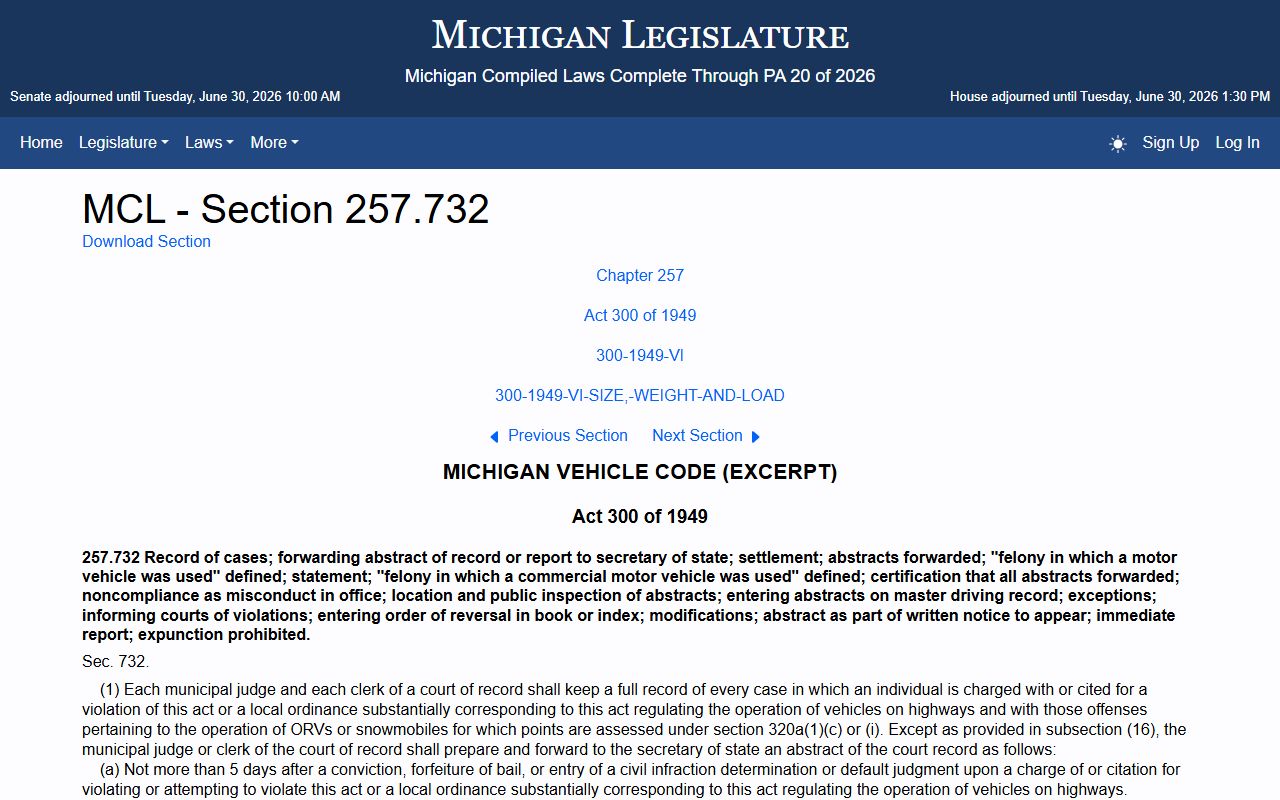
Because that statute sends every Lapeer County traffic conviction to the state, points follow the case even after the local fine is paid.
Points cannot be bargained locally. The magistrate can adjust a fine, but the magistrate cannot waive or reduce points. Points are assessed by the Secretary of State after the conviction is reported under MCL 257.732.
Court Traffic Record vs State Driver Record
These are two different files, and mixing them up causes real confusion. The court traffic record lives with the 71A District Court and covers one ticket. The state driver record lives with the Secretary of State and sums up your license history. One proves what a court did. The other shows license status, points, and reported convictions across time.
The comparison below lines the two records up by source, contents, access, and how to fix an error.
| Aspect | Court Traffic Record | State Driver Record |
|---|---|---|
| Record source | Held by the 71A District Court for the ticket and case. | Held by the Michigan Secretary of State. |
| What it shows | Citation, case number, court dates, plea, hearing, fine and costs, and disposition. | License status, points, suspensions, and reported convictions. |
| Where to access | MiCOURT and the 71A District Court counter for certified copies. | The Secretary of State driving-record service. |
| How to correct errors | Ask the 71A District Court to review the case file. | Ask the Secretary of State about the driving record; the magistrate cannot change points. |
You can order or review your official driving record on the Michigan Secretary of State driving-record page.
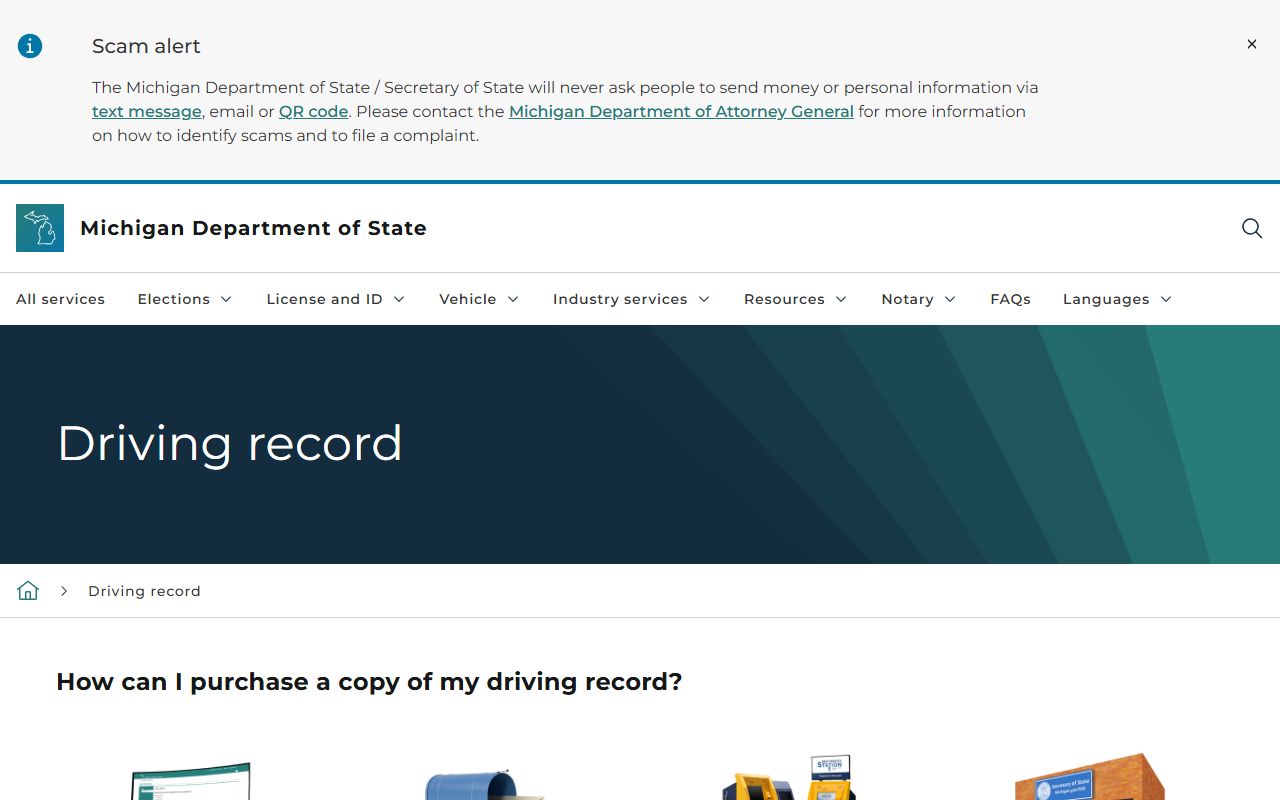
That state record is where points and license status appear, so a full picture of a Lapeer County ticket needs both the court file and the driver record.
Public Access to Lapeer County Traffic Court Records
Traffic court files are public unless a rule or order makes them nonpublic. Court case records are governed by court rule rather than the general open-records process, so inspection, copies, and certified copies follow the clerk's case-file procedures. For sheriff crash reports or other law-enforcement records, the county public-records process applies instead. Starting at the right door saves a wasted trip.
Key Statutes:
Michigan Court Rule 8.119 - court records are maintained and accessed under court rule, with protection for nonpublic material.
MCL 15.231 - Michigan policy favors public access to government records, though courts apply their own rules to case files.
Note: staff at the 71A District Court can explain how to inspect a traffic file or order a copy, but they cannot give legal advice about a case.
CDL and Commercial Driver Records
Commercial drivers carry a higher stake on every ticket. A civil infraction that a private driver shrugs off can shadow a career for a person who holds a commercial driver license. The reason sits on the state side, not the court side. When the 71A District Court reports a conviction to the Secretary of State, the outcome lands on the driving record that employers and commercial programs review.
That is why the state driver record, not the single court file, is the document that follows a commercial driver. It shows the license status and the reported convictions over time. A commercial driver who wants the complete story should pull the driving record from the Secretary of State and compare it against the court disposition. If the two disagree, the court file settles what actually happened in the case.
DUI and OWI Traffic Cases in Lapeer County
An impaired-driving charge is not an ordinary ticket. In Michigan the charge is operating while intoxicated, and it is a criminal case rather than a civil infraction. A misdemeanor OWI is handled at the 71A District Court through arraignment, plea, and sentencing. A felony version begins there and can bind over to the 40th Circuit Court. Because the stakes include jail, a driver license sanction, and a criminal record, these files sit outside the routine traffic division.
For the full case file, charges, and sentencing detail, see the Lapeer County criminal court records.
Deferred Options for Lapeer County Traffic Tickets
Some drivers ask whether a class or a deferral can erase points. The honest answer for Lapeer County is limited. The local route is admit-with-explanation, where a driver accepts responsibility and asks the magistrate to consider the situation. The magistrate may adjust the fine on that basis. What the magistrate may not do is remove or shrink the points, because the Secretary of State assesses those after the conviction is reported.
No county-run defensive-driving dismissal program appears in the official Lapeer County court sources. Any question about a deferral, a class, or an alternate outcome should go straight to the 71A District Court, since only the court can confirm what is available on a given citation. Never rely on an outside promise that a course will clear the state points.
Setting Aside or Sealing Lapeer County Traffic Records
Michigan uses the term set aside for clearing eligible convictions. A civil infraction is not a conviction, so it is handled differently from a criminal set-aside. A traffic misdemeanor may fall under the set-aside laws, though certain traffic offenses are excluded, and impaired-driving convictions have their own limits. The application process and the newer automatic Clean Slate rules govern which convictions leave public view and when.
One point trips up many people. A set-aside that clears a public court record does not automatically wipe the Secretary of State driving record. The driving history and any points can persist under separate state rules even after a court record is cleared. A driver seeking a clean slate should confirm the effect on both files, not just the court side.
Fees for Lapeer County Traffic Court Records
The 71A District Court charges set fees for copies and a few case actions. Ticket fines and costs are a separate matter, and they vary by the offense charged. The official court sources do not publish a full list of every fine, so those amounts are confirmed on the citation or at the counter rather than guessed at here.
The table lists the record and case fees documented in the district court schedule.
| Item | Amount |
|---|---|
| Certified copies | $10 plus $1 per page |
| Forms | $1 each |
| Appeals from District Court | $25 |
| Credit card payment | Additional fee applies |
| Ticket fines and costs | Vary by offense; not fully listed in official sources |
| State driving record | Secretary of State fee applies; verify current amount |
Note: request a certified copy when you need proof for insurance, an employer, or a legal matter, since an uncertified printout may not be accepted.