
Criminal Court Records in Lapeer County
A criminal court record is the case file the court clerk opens the moment charges are filed. It is not built by the police. It is built by the court as the case moves through hearings. The file holds the complaint or warrant, the arraignment entry, bond terms, motions, the plea or verdict, the disposition, and the judgment of sentence. The Lapeer County Clerk, Theresa Spencer, serves as clerk of the 40th Circuit Court and keeps the felony case files. The 71A District Court keeps its own misdemeanor and traffic case files. The charges themselves come from the Prosecuting Attorney, not the clerk. For a closer look at how those charges are filed and how they change, the Lapeer County arrest records and court charges page walks through the charging side.
Two trial courts share the criminal workload in this county. The 71A District Court handles misdemeanors, arraignments, bond, and the felony preliminary examination. The 40th Circuit Court handles felonies after bindover and criminal appeals from the District Court. Both courts sit inside the county complex on Clay Street in the City of Lapeer.
Every criminal case begins as a public court file unless a statute or court rule makes it nonpublic. A dropped charge still leaves a record. A dismissal still leaves a record. Reading the disposition is the only reliable way to learn how a case actually ended.
How a Criminal Case Moves Through Court
A Michigan criminal case follows a set path, and each step leaves its own mark in the record. Felony and misdemeanor cases both start in the District Court. Only felonies climb to the Circuit Court, and only after a preliminary examination or a waiver. Watching the docket move from stage to stage tells you where a case stands today.
Case flow: Charges Filed › Arraignment › Preliminary Exam / Pretrial › Plea or Trial › Disposition › Sentencing
- Charges Filed
- The Prosecuting Attorney reviews the report and files a complaint or warrant. This opens the court case and sets the charge count.
- Arraignment
- The defendant appears in the 71A District Court. Charges and rights are read, a plea may be entered, and a magistrate or judge sets bond.
- Preliminary Exam or Pretrial
- For a felony, the District Court holds a preliminary examination to decide whether probable cause supports a bindover to Circuit Court. Misdemeanors move to pretrial conferences instead.
- Plea or Trial
- Most cases end in a plea. Others go to a bench or jury trial. After bindover, the Circuit Court files an information that states the felony charges formally.
- Disposition
- The record shows the result of each charge: guilty, not guilty, dismissed, reduced, or bound over. This is the field that answers how the case ended.
- Sentencing
- After a conviction the judge imposes a sentence. The judgment of sentence lists jail or prison time, probation, fines, costs, and restitution.
Note: felony cases physically move from the 71A District Court file to the 40th Circuit Court file at bindover, so the same matter can carry two case numbers.
How to Search Lapeer County Criminal Court Records
The first online stop is MiCOURT Case Search, the statewide trial court portal that indexes Lapeer's Circuit, District, and Probate cases. It returns the index, docket, parties, hearings, and case status. It is not a full document library, so certified copies still come from the court that owns the file. Choose the correct court before you search, because a felony after bindover sits in the Circuit Court while a misdemeanor sits in the District Court.
- Open the Michigan MiCOURT Case Search portal.
- Select the court first. Pick 40th Circuit Court for felonies after bindover, or 71A District Court for misdemeanors, traffic, and arraignments.
- Search by case number when you have it, since common surnames return many matches.
- To search by name, enter the exact last and first name, and be ready for a date-of-birth prompt on criminal searches.
- Open the matching case and record the case number, charges, plea, disposition, sentence, and hearing dates.
- Request a certified copy from the Circuit Court Clerk or the District Court if you need the document itself.
When the file is not online, use the counter or the phone. The Circuit Court answers at 810-667-0358 and the District Court at 810-667-0314. Staff can explain access but cannot give legal advice or confirm a nonpublic case exists. For a statewide criminal history rather than one case file, the Michigan State Police run ICHAT, a separate paid search.
What a Lapeer County Criminal Court Record Shows
A criminal case file is organized by field, and knowing each field makes the record readable. The case number carries a year, a sequence number, and a two-letter case-type code such as FH for a felony. The docket then lists every event in order, from the complaint through the judgment of sentence. The table below breaks down the fields you will meet most often in a Lapeer County criminal court record.
| Field | What It Shows |
|---|---|
| Case Number | Year, sequence, and case-type code such as FH for a felony or a misdemeanor suffix. |
| Court | 40th Circuit Court for felonies, or 71A District Court for misdemeanors and traffic. |
| Parties | Listed as People of the State of Michigan versus the named defendant. |
| Charges | Each count, the statute cited, and the severity level filed by the prosecutor. |
| Bond | Release conditions and any money or surety tied to future appearances. |
| Plea | The defendant's formal answer to each charge, such as guilty, not guilty, or no contest. |
| Docket Entries | Complaint, arraignment, exam, motions, orders, and hearing notices in date order. |
| Disposition | The outcome of each charge: convicted, dismissed, reduced, acquitted, or bound over. |
| Sentence | Jail or prison time, probation, fines, costs, and restitution from the judgment of sentence. |
Some fields never appear in a public view. Social security numbers, financial account numbers, victim information, and certain birth dates are redacted. Online dockets often show the text of an entry without the underlying document image.
Reading Dispositions and Sentences
The disposition is the field that answers the real question: what happened to the charge. A guilty plea and a jury conviction both read as convictions. A dismissal, an acquittal, or a nolle prosequi entry means no conviction stands. A charge can also be reduced, so the count filed at arraignment is not always the count at sentencing. Read the disposition next to each charge, not the charge alone.
The sentence sits in the judgment of sentence. It can order jail time in the county, prison time under the state, probation, fines, court costs, and restitution to victims. Probation puts a person under court supervision instead of, or after, custody. A few defendants route into the county's Mental Health Court or jail diversion track, coordinated through Lapeer County Community Mental Health, which can change how a case is supervised and closed.
- Disposition
- The final or current outcome of a charge or the whole case.
- Nolle prosequi
- A prosecutor's decision to drop a charge before a verdict.
- Restitution
- Money the court orders a defendant to pay to compensate victims.
- Probation
- Court supervision imposed instead of, or after, jail or prison.
Charges vs Convictions in Lapeer County Cases
Being charged is not the same as being convicted. A charge is only an accusation the prosecutor has decided to pursue. A conviction is a finding of guilt by plea or verdict. A Lapeer County criminal court record can list charges that were later dropped, dismissed, reduced, or that ended in acquittal. Reading the two as if they were the same is the most common mistake people make with these files.
| Charge | Conviction | |
|---|---|---|
| Meaning | Formal accusation filed by the prosecutor | Finding of guilt by plea or verdict |
| Stage | Start of the case | After trial or a guilty plea |
| Burden of Proof | Probable cause | Proof beyond a reasonable doubt |
| What It Proves | The case may proceed | Legal guilt is established |
| Public Record | Yes, unless restricted | Yes, unless set aside |
The distinction matters for background checks. A dismissed charge should never be reported as a conviction. Always confirm the disposition against the certified court file before treating a charge as proven.
Lapeer County Prosecutor and Victim Rights
Criminal charges in this county come from the Lapeer County Prosecuting Attorney, John D. Miller. His office decides what to file, argues the case in court, and handles victim services along the way. That is why a prosecutor's name and victim-rights entries show up inside criminal dockets. The office describes its mission as justice for county residents and compassionate assistance to crime victims.
The prosecutor's public page is the clearest local source on the office and the criminal process. You can review the Lapeer County Prosecuting Attorney office for staff contacts and victim resources.
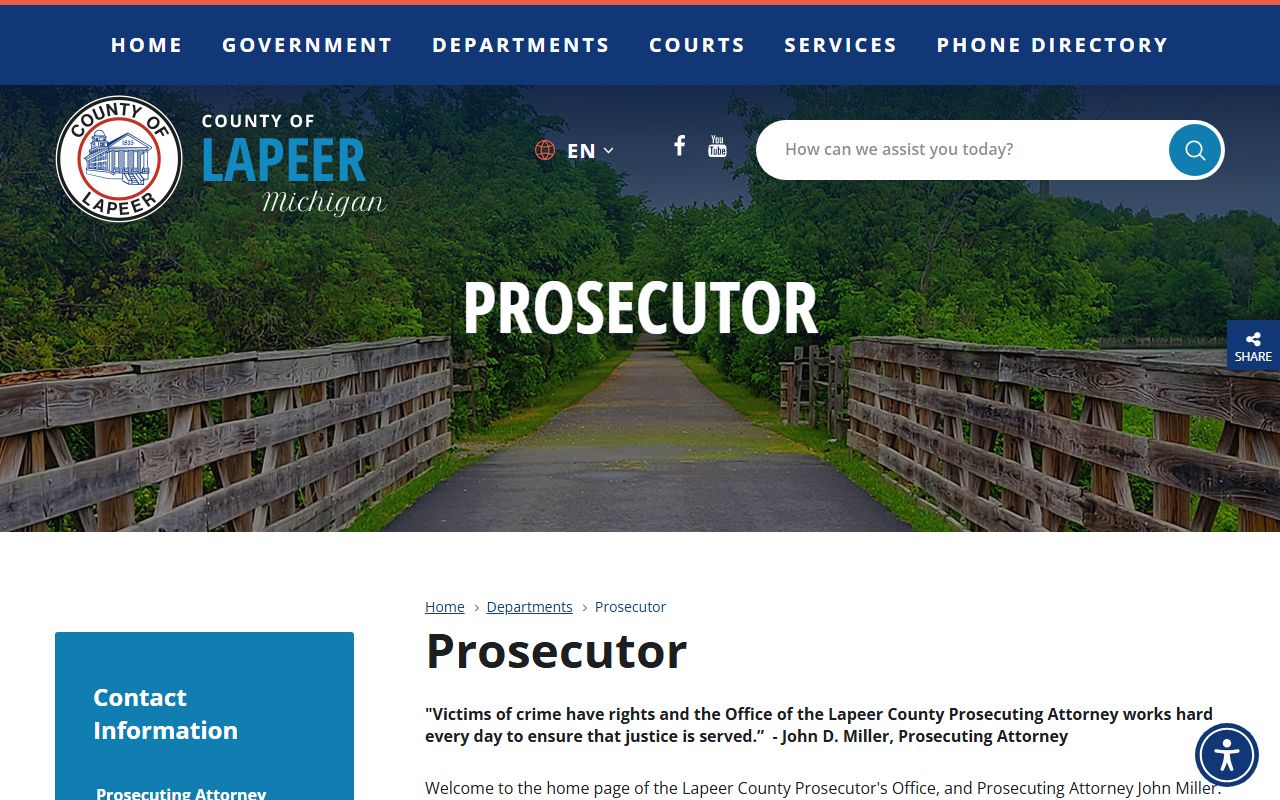
The page names John D. Miller as Prosecuting Attorney, Paul Walton as Chief Assistant, and Danielle Cusson as Assistant Prosecuting Attorney, alongside victim-rights contacts.
Michigan gives crime victims specific rights under the state Constitution and the Crime Victim's Rights Act, MCL 780.751. Those rights include fairness and respect, notice of scheduled court proceedings, notice of a defendant's release, the chance to confer with the prosecutor, an impact statement, and restitution. Christy Podhorsky and CeLes Sullivan are listed as victim-rights contacts. Victims who want to track a case can reach the office directly.
John D. Miller
255 Clay St.
Lapeer, MI 48446
810-667-0326
ICHAT Versus the Lapeer County Court File
An ICHAT report and a court case file are two different products, and people often confuse them. ICHAT is the Michigan State Police statewide criminal-history search. It reports arrests and convictions that agencies sent to the state. A court case file is the local record of one case, with its docket, disposition, and certified copies. ICHAT can miss a local detail, and it is never a substitute for a certified court disposition.
State prison and parole status is a third source again. The Michigan Department of Corrections runs OTIS, its offender tracking system, for people sentenced to state custody. A county jail stay does not appear there. Federal criminal cases are separate too, since Lapeer sits in the U.S. District Court for the Eastern District of Michigan and those matters are prosecuted by the U.S. Attorney, not the county.
The federal side has its own charging authority. You can view the U.S. Attorney for the Eastern District of Michigan for the office that files federal charges affecting county residents.
Federal cases are filed in Detroit or Flint rather than the Lapeer courthouse, so their records live in the federal PACER system, not MiCOURT.
Note: a certified disposition from the convicting court is the record that controls, not a commercial background report or a single statewide search.
Public Access to Lapeer County Criminal Court Records
Court case records are governed by court rule, not by the same process as county agency records. Michigan court rules recognize public access to court files unless a statute or order makes a record nonpublic. That is why the clerk's counter, MiCOURT, and certified-copy requests are the main channels for a case file. For sheriff incident reports or county administrative records, the Freedom of Information Act applies instead.
The Crime Victim's Rights Act, shown on the Michigan legislature site, also shapes what appears in a criminal docket. You can read the full text of the Crime Victim's Rights Act statute for the rights it grants.
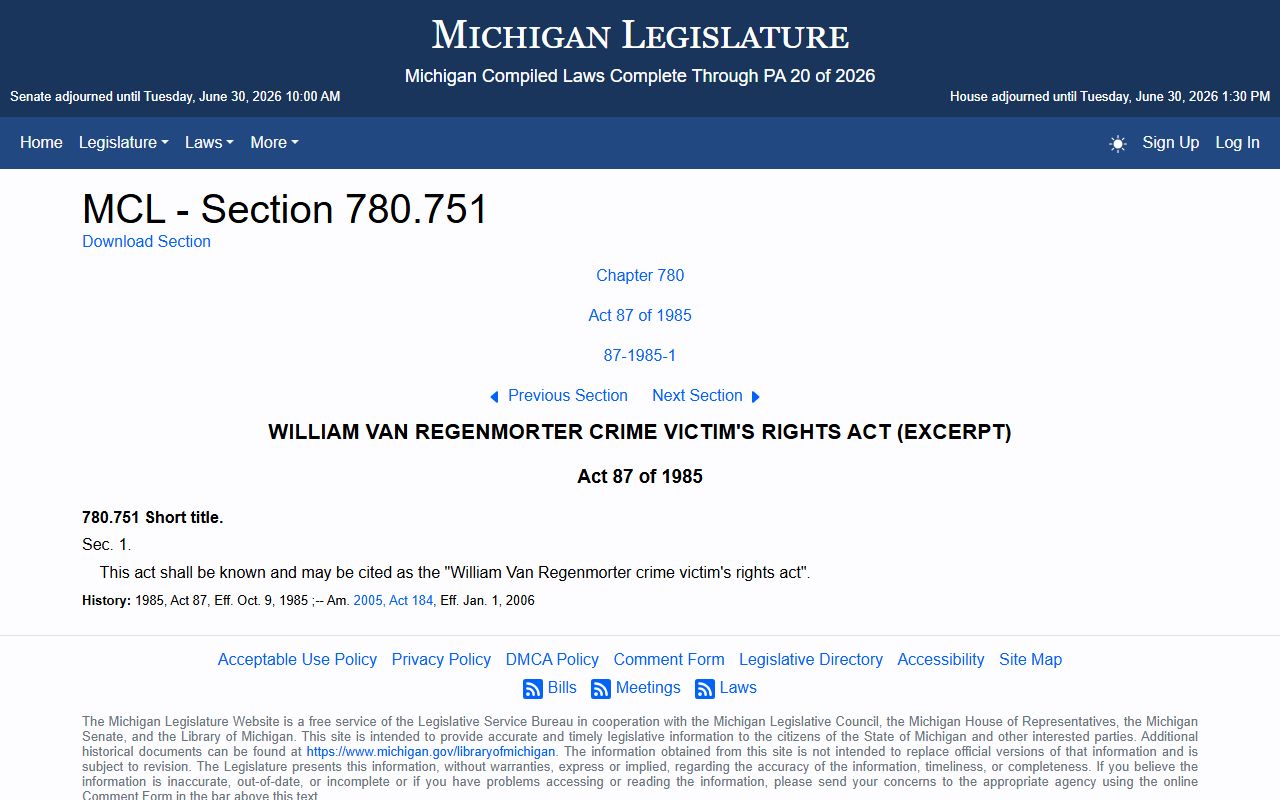
These rights explain why victim contacts, notice entries, and restitution orders sit inside the public case file.
Key statutes:
MCR 8.119 sets how Michigan court records are kept and accessed, with protection for nonpublic material and personal identifiers.
MCL 15.231 states Michigan's policy favoring public access to government records, while court cases follow court rules.
Sealed vs Expunged Lapeer County Criminal Records
In Michigan the word for clearing a conviction is set aside, which functions as expungement. A sealed record is hidden from public view but still exists in the court system. A set-aside record is treated in law as if the conviction never occurred, though it is not physically destroyed. The state's Clean Slate law now clears many eligible convictions automatically after a waiting period.
| Sealed | Set Aside (Expunged) | |
|---|---|---|
| What It Means | File hidden from public view | Conviction treated as if it never happened |
| Public Visibility | Removed from ordinary searches | Removed from MiCOURT and ICHAT public results |
| Law Enforcement | Limited access remains | Access retained for allowed uses under statute |
| Michigan Mechanism | Court order or rule restricting access | Application or automatic set aside |
| Governing Law | Court rule and order | MCL 780.621 and Clean Slate MCL 780.621g |
The Michigan legislature publishes the application rules. The set-aside application statute, MCL 780.621, governs which convictions qualify and how to apply.
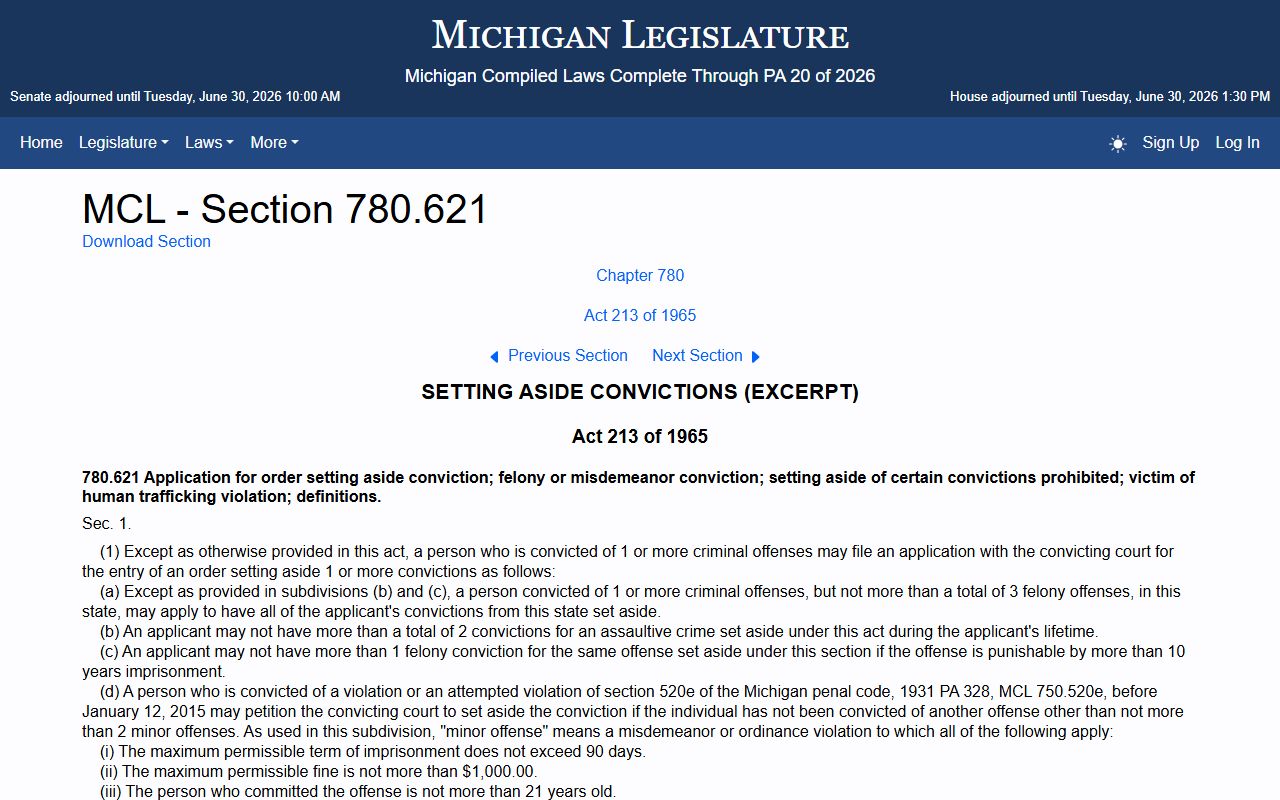
Clearing a Michigan conviction follows a defined path, whether it happens by application or automatically.
- Identify the convicting court, the case number, the charge statute, and the conviction and sentence dates.
- Check eligibility under MCL 780.621 and the Clean Slate provisions for that offense type.
- If it qualifies for automatic set aside under MCL 780.621g, the state may clear it after the statutory waiting period with no application.
- If an application is required, file in the convicting court, serve the required agencies, and attend any hearing the judge orders.
- If granted, the conviction becomes nonpublic, though law enforcement, courts, and licensing agencies may still access it in situations the statute allows.
Note: setting aside a traffic offense does not automatically remove it from the Secretary of State driving record, which follows its own rules.
Restricted Criminal Court Records in Lapeer County
Not every criminal matter is open to the public. Juvenile delinquency and child-protective cases run through the Circuit Court Family Division, and their records are restricted under juvenile statutes such as MCL 712A.28. Set-aside convictions drop out of ordinary public searches. Sealed search warrants and sealed indictments stay hidden until a court unseals them. Protected personal identifiers are redacted from what remains public.
To find all court record types beyond the criminal file, the Lapeer County court records page maps the civil, family, and probate channels. For the criminal file itself, the case number and disposition remain the two anchors to trust.
Important: This site is not a consumer reporting agency under the Fair Credit Reporting Act, and its information cannot be used for employment, tenant, or credit decisions.